 Skip to content
 IVF Treatment
In Vitro Fertilisation (IVF) is an assisted reproductive treatment that helps fertilisation take place outside the body in a laboratory.
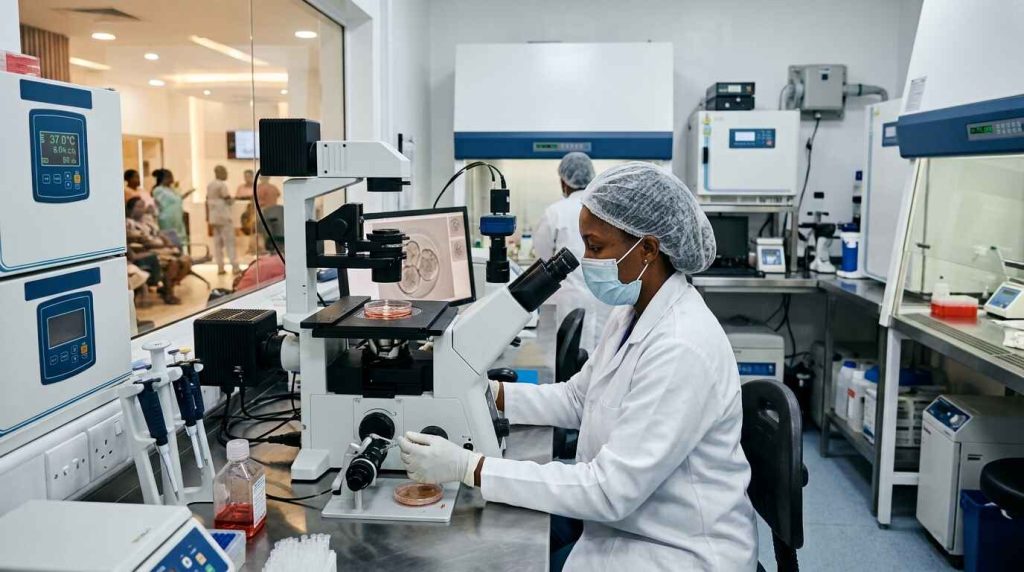
At Iatros Specialist Hospital, IVF treatment begins with an assessment of your fertility needs and a treatment plan developed around your individual circumstances. The process may involve ovarian stimulation, monitoring, egg retrieval, fertilisation in the embryology laboratory, embryo development and transfer.
Your fertility specialist will explain each stage of treatment, the investigations required and the options available to you before treatment begins.
What Is IVF?
VF involves collecting eggs from the ovaries and combining them with sperm in the laboratory to allow fertilisation to occur. Embryos that develop appropriately may then be transferred into the uterus.
IVF can be used in the management of different causes of infertility and may also be considered when other fertility treatments have not resulted in pregnancy.
The appropriate treatment depends on factors such as age, ovarian reserve, sperm factors, previous treatment history and other findings from your fertility assessment.
What Does the IVF Process Involve?
1. Fertility Assessment
Your specialist reviews your medical and fertility history and recommends the investigations needed to understand your circumstances.
2. Ovarian Stimulation
Medication may be used to stimulate the ovaries to develop multiple follicles. Your response is monitored during the cycle.
3. Egg Retrieval
When the follicles are ready, the eggs are collected using a carefully planned procedure.
4. Fertilisation
The eggs are taken to the embryology laboratory, where they are combined with sperm. Depending on the circumstances, conventional IVF or ICSI may be used.
5. Embryo Development
Embryologists monitor the embryos as they develop and assess their suitability for transfer or preservation.
6. Embryo Transfer
A selected embryo may be transferred into the uterus as part of the treatment cycle.
7. Pregnancy Testing
Your clinical team will advise you when to carry out the appropriate pregnancy test following embryo transfer.
Who it suits
- Blocked or damaged fallopian tubes
- Unexplained infertility after other treatments
- Moderate to severe endometriosis
- Reduced ovarian reserve, where time matters
- Couples who have tried IUI without success
If male-factor infertility is the main finding, we will usually recommend ICSI instead.
Your IVF cycle, week by week
Stimulation and monitoring
Daily injections you give yourself at home, with three or four short scans to track how the follicles are responding.
Egg collection
A 20-minute procedure under sedation. You go home the same morning; most people rest for the day.
Fertilisation and embryo culture
Eggs and sperm are combined in the laboratory. We phone you with a fertilisation report the next morning and again before transfer.
Embryo transfer
A few minutes, no anaesthetic. Your pregnancy test is 10–12 days later, at the clinic.
stimulation to embryo transfer
- All scans and monitoring during the cycle
- Egg collection under sedation
- Laboratory fertilisation and embryo culture
- One fresh embryo transfer
- Vitrification of surplus embryos, first year included
Your written quote is issued after your consultation and holds for 90 days. Most insurers require pre-authorisation.
Frequently asked
How many injections will I have to give myself?
Usually one or two a day for 10 to 12 days. Our fertility nurse teaches you on a practice pen, and you can phone the nurse line at any point.
Is egg collection painful?
You are sedated, so you will not feel it and most people remember nothing. Afterwards, expect period-like cramping for a day.
How many embryos will you transfer?
Usually one. Transferring two raises the twin rate sharply, and a twin pregnancy carries real risk to you and the babies. We discuss it case by case.
What happens to embryos we do not use?
With your consent they are vitrified and stored for a later transfer. Storage, extension and disposal choices are all set out in the consent forms you sign before treatment.
You may also want to read
ICSI
When a single sperm is injected into each egg.
Vitrification of embryos
Freezing surplus embryos for a later transfer.
Fertility evaluation & treatment
The testing that decides whether IVF is right.
Ask us whether IVF is really your best option.
We will say so if it is not. Consultations carry no obligation to treat.
