 Skip to content
 ICSI Treatment
Intracytoplasmic Sperm Injection (ICSI) is a specialised fertilisation technique used as part of IVF treatment.
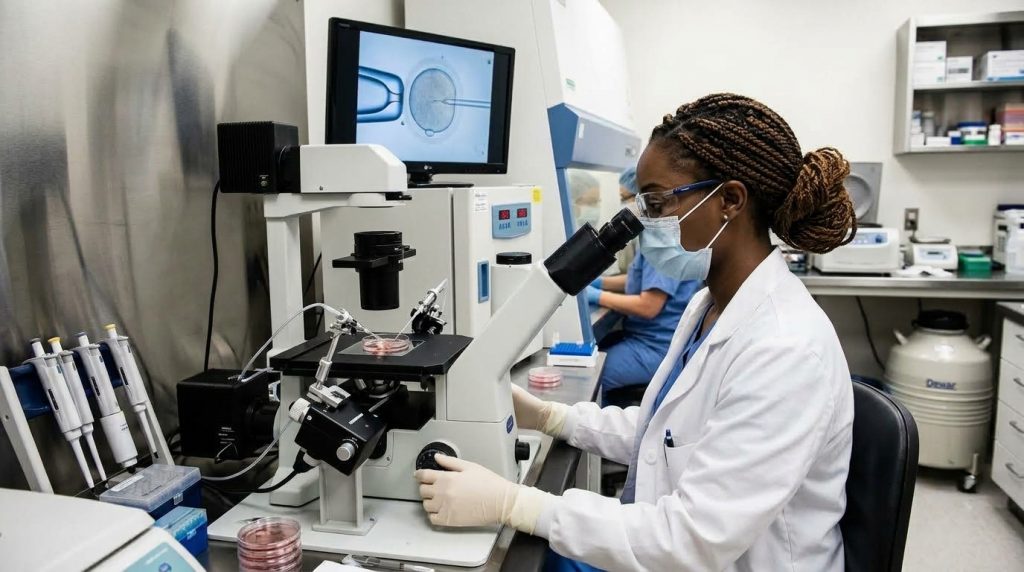
During ICSI, an embryologist injects a single sperm directly into a mature egg to assist fertilisation.
At Iatros Specialist Hospital, ICSI is considered as part of an individual fertility treatment plan. Your fertility assessment helps determine whether ICSI or conventional IVF is more appropriate for your circumstances.
What Is ICSI?
ICSI is a laboratory technique used during IVF treatment.
Rather than placing eggs and sperm together and allowing fertilisation to occur naturally in the laboratory, ICSI involves the direct injection of a selected sperm into an egg.
Following fertilisation, the resulting embryo is monitored in the embryology laboratory before an appropriate next step is determined.
How Does ICSI Work?
Step 1 — Fertility assessment
Your fertility specialist evaluates the relevant fertility factors.
Step 2 — IVF preparation
Eggs are collected as part of the IVF cycle.
Step 3 — Sperm preparation
The embryology team prepares and selects appropriate sperm for the procedure.
Step 4 — Sperm injection
A single sperm is injected directly into a mature egg using specialised laboratory equipment.
Step 5 — Embryo development
Fertilised eggs are monitored as embryos develop.
Step 6 — Embryo transfer or preservation
Depending on the treatment plan, an appropriate embryo may be transferred or preserved for future treatment.
Who it suits
- A low sperm count, poor movement or abnormal shape
- Sperm retrieved surgically from the testis or epididymis
- Previous IVF where few or no eggs fertilised
- Frozen sperm samples of limited quantity
- Couples using sperm banked before cancer treatment
ICSI does not improve results for couples with normal sperm — we will not add it as a routine upsell.
What is different, step by step
Stimulation, exactly as IVF
The same injections, the same monitoring scans, the same timeline.
Egg collection and sperm preparation
Eggs are collected under sedation while the laboratory prepares and assesses the sperm sample.
Injection
Each mature egg is injected with one selected sperm and returned to the incubator. We report fertilisation the next morning.
Transfer and freezing
The best embryo is transferred; suitable surplus embryos are vitrified.
stimulation to embryo transfer, ICSI included
- Everything in a standard IVF cycle
- Sperm preparation and assessment
- Micro-injection of every mature egg
- Daily embryology updates by phone
- Vitrification of surplus embryos, first year included
Your written quote is issued after your consultation and holds for 90 days. Most insurers require pre-authorisation.
Frequently asked
Is ICSI safer or riskier than IVF?
Large studies show broadly similar outcomes for children conceived by either method. Where the male factor is inherited, we offer genetic counselling before treatment.
Do you need a fresh sample on the day?
Usually yes, produced privately at the clinic on the morning of egg collection. Where that is difficult, a sample can be frozen in advance or retrieved surgically.
What if no eggs fertilise even with ICSI?
It is uncommon but possible. Your consultant and embryologist will review the cycle with you in person and explain what the finding means for any future attempt.
Can we choose ICSI just to be safe?
You can ask, but we will give you our honest view. With normal sperm parameters, conventional IVF gives equivalent results at lower cost.
You may also want to read
IVF
The cycle ICSI sits inside.
Fertility evaluation & treatment
Semen analysis and the tests that point to ICSI.
Vitrification of embryos
Storing the embryos you do not transfer.
Bring us the semen analysis.
We will tell you whether ICSI genuinely changes your odds.
