 Skip to content
 Embryo vitrification is a rapid freezing technique used to preserve suitable embryos for future fertility treatment.
During vitrification, embryos are exposed to protective solutions and rapidly cooled to preserve them at very low temperatures.
At Iatros Specialist Hospital, embryo vitrification is part of our fertility and embryology services and may be considered when embryos are suitable for preservation.
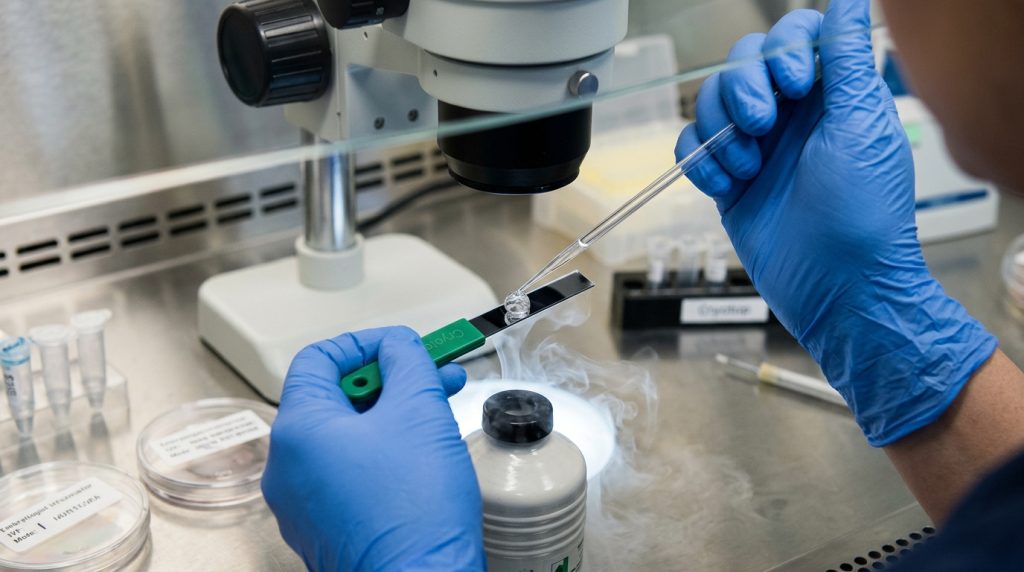
What Is Embryo Vitrification?
Vitrification is a rapid cryopreservation technique used to preserve embryos.
Unlike traditional slow-freezing methods, vitrification involves very rapid cooling that reduces the formation of ice crystals within the embryo.
Embryos that are considered suitable for freezing can be preserved for potential future treatment according to the patient’s treatment plan.
Why Are Embryos Vitrified?
Embryo vitrification may be considered for several reasons, including:
- Preserving suitable embryos that are not transferred during the current treatment cycle
- Planning a future frozen embryo transfer
- Fertility treatment strategies that require embryo preservation
- Circumstances where embryo transfer needs to take place at a later time
- Other clinical circumstances determined by the fertility team
How Does Embryo Vitrification Work?
Embryo assessment
Embryos are assessed by the embryology team to determine their suitability for preservation.
Preparation
Suitable embryos are prepared using specialised cryoprotective solutions.
Rapid freezing
The embryo is rapidly cooled using vitrification technology.
Storage
The vitrified embryo is stored under controlled cryogenic conditions.
Future use
When appropriate, a preserved embryo may later be warmed as part of a planned treatment cycle.
Who it suits
- Couples with more good embryos than they will transfer now
- Patients at risk of hyperstimulation, where a fresh transfer is unsafe
- Anyone hoping for a second child from the same cycle
- Patients about to start chemotherapy or similar treatment
- Cycles where the womb lining is not ready for a fresh transfer
From surplus embryo to later transfer
Selection
Vitrification
Held until you are ready
Warming and transfer
- Embryo selection and grading
- Vitrification of all suitable embryos
- Labelling, inventory and first-year storage
- Written consent and records
- A survival report when embryos are warmed
Frequently asked
How long can embryos stay frozen?
Do embryos survive thawing?
Is a frozen transfer as good as a fresh one?
What happens if we separate or change our minds?
You may also want to read
IVF
The cycle that produces the embryos.
ICSI
How those embryos are fertilised.
Transport IVF
Monitoring near home, laboratory work here.
